

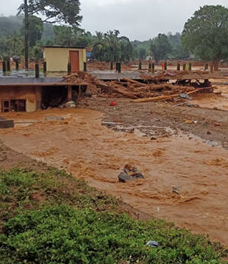
Wayanad Floods: Insights from a Climate Change Perspective- July 2024
Wayanad district of Kerala reeled from destruction wreaked by one of the most devastating landslides triggered by incessant Monsoon rains this July. During the wee hours of July 30, multiple landlines swept away several villages in the district. The tragedy has claimed over hundreds of lives and injured several.

Climate Change Impacts: Uttarakhand breaks rainfall and heat records- July 2024
Uttarakhand has witnessed extreme weather conditions during the first two months of Monsoon. While June witnessed record-breaking maximum temperatures, July has been witnessing a series of extremely heavy Monsoon rains triggering flash floods and landslides.

Changing Horticultural Production in Uttarakhand under Conditions of Global Warming

India's tryst with Heatwaves and Changing Monsoon Patterns amid Climate Change: A Report (June 2024)

Changing Horticultural Production in Uttarakhand under Conditions of Global Warming: An Analysis (May 2024)
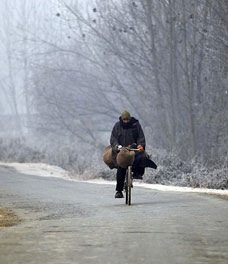
Warmer Winters 2024: Himalayas will bear maximum brunt of Climate Change (February, 2024)

The 2022 Indian Heatwaves

Cyclone Michuang Mayhem: El Nino, climate change multiplies storm’s impact by manifold
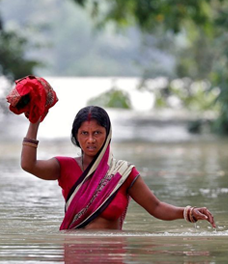
Changing Monsoon Dynamics: A district level retrospective of Monsoon 2023 (Oct 2023)
The Southwest Monsoon concluded with 94% of the rainfall, with 73% of the country’s area receiving normal rains. However, rings dissonant with the stream of headlines that swung through the season between apocalyptic rainfall and crippling deficits.
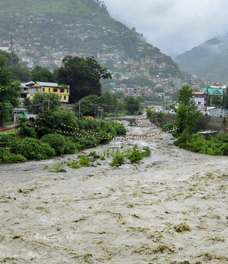
Sikkim floods: Role of climate change and what lies ahead (Oct 2023)
As Sikkim battled with flash floods, scientists warned that what happened was the disaster in waiting. The event was predicted way back in 2021 itself when a study brought forth information about the increasing length of Lhonak Glacial Lake, which was sensitive to extreme weather events such as cloudbursts.

Monsoon 2023 to end with below-normal rains, global warming fuels erratic weather (Sept 2023)
The Southwest Monsoon 2023 ends on September 30, with India ending the season as ‘Below-Normal’. Extreme weather events continued to govern the four-month-long season.

Explainer Half-way into Monsoon 2023 marks climate change multiplying extreme events in India (Aug 2023)
Monsoon 2023 recently concluded its half-way journey, with the country recording normal rains at the end of July. However, the season so far has been marred by extreme weather events, from humid heatwaves to cyclones to torrential rains.

Explainer Monsoon fury in U'khand & HP as climate change alters humidity, temperature pattern (Aug 2023)
The ongoing floods and devastation in the Himalayan states of Himachal Pradesh and Uttarakhand are proof of the increasing climate risks to an already vulnerable and fragile ecosystem. Scientists attribute rising temperatures to the increased atmospheric evaporation and humidity levels for the sudden extreme rains.

Monsoon Fury 2023: Climate change makes extreme events new normal (Jul 2023)
Extremely heavy rainfall wreaked havoc across Northwest India. Incessant rains triggered flash floods and landslides across Himachal Pradesh, while Delhi recorded the highest rains in the last 40 years. Both meteorologists and climate scientists have been blaming increasing levels of global warming for a steep increase in extreme weather events.

Know how Cyclone Biparjoy is impacting Monsoon 2023 and the role of climate change (Jun 2023)
The formation of Cyclone Biparjoy is yet another example of the rapid intensification of any system due to ocean warming. Biparjoy intensified from cyclonic circulation to a severe cyclonic storm in less than 48 hours.

Cyclone Mocha: How climate change is making cyclones more intense (May 2023)
The month of May is conducive for cyclogenesis in the Indian Ocean. Therefore, cyclone Mocha’s formation is a seasonal pattern. What is uncharacteristic is the rapid intensification of these storms, and scientists and researchers blame the increasing global mean temperature for the changes in cyclogenesis, particularly over the Indian Ocean.

Climate Change: India to witness surge in extreme weather due to rising heat stress - March 11, 2023
Increasing temperatures, courtesy climate change, is leading to unseasonal rains across India. Though these rains were termed as pre-Monsoon showers, they had begun before schedule this year on account of rising heat stress across the country. Pre-Monsoon weather activities start making an appearance by the second half of March. According to scientists, increasing temperatures as early as in February have led to formation of local weather systems before time. In fact, if the warming continues, these convective systems will continue to form at frequent intervals on account of increased humidity levels, triggering more freak weather events. These variations in climate systems can be attributed to climate change.

The impact of changing patterns of Western Disturbances and La Niña on warmer winters - March 9, 2023
Shifts in climate patterns are impacting the Indian Winter season. Like 2022, Winter in India had bid adieu to the country early this year too. In fact, February 2023 was the hottest since 1901, when state-run IMD first started collecting data. According to scientists, the prevailing weather conditions are a result of increasing global warming, which they have been warning against for very long now. Continuous increase in the global mean temperatures have been impacting dynamics of the larger weather phenomena such as Western Disturbances and ENSO (El Nino Southern Oscillation). Change in characteristics of these systems have largely affected the precipitation over India during the winter season.

El Nino scare looms over Monsoon 2023, climate change to aggravate situation – February 15, 2023
A research paper on the upcoming El Nino season and its impact on the Indian Monsoon amidst the climate change impacts. Climate models are predicting a dominating chance of El Niño by May-July 2023. The evolving phase of El Niño coincides with summer Monsoon that spans from June- September. El Nino is invariably linked with below normal Monsoon rains and in the past has led to some severe droughts during the El Niño years. The four-month long Southwest Monsoon contributes close to 75% per cent to the annual rainfall in India and irrigates over half of India’s agricultural land. El Niño will also lead in increasing the global mean surface temperature as the ocean transfers heat to the atmosphere.

The urgency of urban flooding: What Bengaluru floods 2022 taught us - September 13, 2022
Climate change impacts have been increasing every year, with even more intensity and frequency. Asian urban areas are considered high-risk locations from projected climate change, extreme events, unplanned urbanisation and rapid land-use change. In extreme cases urban floods can result in disasters that set back urban development by years or even decades. All the incidents have shown how the quantum of extreme events have increased exponentially in South Asia. Major cities along with towns now stand at increased risk of flooding. Bengaluru floods 2022 can be considered as a classic case of urban flooding, which highlights the urgent need of urban adaptation and resilience plan.

Absence of winter rains keep pollution levels high across Indo-Gangetic Plains
Worsening air quality continues to be a problem across Indo-Gangetic plains and the peak pollution season is prolonged this year, despite nil contribution from stubble warning. This could be a result of the absence of winter rains across the plains. According to meteorologists, in the absence of any active Western Disturbance, winter rains have remained in hiding. This briefing cites experts and relevant resource materials to help better understand this phenomenon.

Monsoon variability continues to dominate, La Nina pushes India
The Southwest Monsoon 2022 officially came to end on September 30, with the country recording above normal rains to the tune of 106%. These surplus rains can be attributed to the La Nina conditions prevalent in the Pacific Ocean. Despite the cumulative above normal rains, the spatial distribution remained erratic. 187 districts of the country recorded deficit rainfall, while seven districts were in large deficit. According to experts, Monsoon variability continued to dominate the four-month long season. Rainfall statistics confirmed the same where Central India recorded above normal rains by 22%, while the East & Northeast India was deficit by 18%. This briefing cites experts and relevant resources to better understand this phenomenon.

Understanding Loss & Damage in a rapidly changing climate
Loss and damage (L&D) refers to the impacts of climate change that cannot be (or have not been) avoided through mitigation or adaptation. Due to human induced climate change, millions of people are today facing the real-life consequences of higher temperatures, rising seas, fiercer storms, desertification, and unpredictable rainfall. A study conservatively estimated the bill from extreme weather events in the twenty most vulnerable low- and lower-middle-income countries at $593 billion, while for India it accounts to $256 billion1 for the time-period 1998-2017. This briefing dives deep unto understanding Loss & Damage from a global and India specific lens.

No place to hide: Tracking climate impacts in 2022

Growing evidence of climate change altering Monsoon systems in Indian Subcontinent, extreme events to be new normal

Know what climate change has done to heatwave in India: An explainer (May 2022)
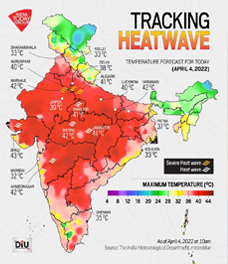
Heatwave grips India early in Summer, many more to come in March (March 2022)
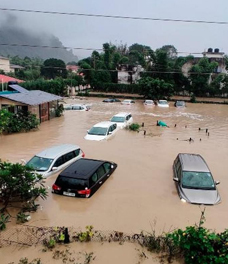
IPCC Report Highlights Physical Climate Risks for Indian Insurers
IPCC’s WG II report, released on Feb 27, 2022, highlights India’s growing vulnerability to climate change. Major floods and landslides killed over 700 people and caused USD 11 billion worth of damage in India over the course of 2018 and 2019. The city of Mumbai is the second most exposed megacity to coastal flooding as a result of sea level rise. Without climate mitigation, the city could suffer economic damages of USD 49-50 billion by 2050 (cumulatively) from coastal flooding alone. India has the world’s second highest exposure to flooding rivers, which could amount to an annual average loss of USD 6 billion. This briefing document highlights how these climate vulnerabilities threaten Indian insurers business models and what they can do to minimise climate risks.

Climate Change to enhance La Niña impact, expect less snowfall, intense cold waves and rise in extreme events in India (December 2021)

Chilly winters courtesy of La Nina, peak stubble burning to worsen air quality in North India (November 2021)

La Nina, IOD, MJO join hands to give torrential rains in Chennai, TN & Andhra Pradesh; Climate change to amplify weather events’ (November 2021)
Tamil Nadu along with coastal Andhra Pradesh recorded extremely heavy rains on account of vigorous Northeast Monsoon conditions. Though direct linkage with climate change cannot be seen but it has definitely let to change in weather patterns causing extreme weather. In the times of rising global temperatures, sea level rise and warmer than average sea surface temperatures, the weather systems react differently than earlier.

Weather conditions to turn hostile, to intensify winter air pollution in West Bengal (November 2021)

Climate Change: Flash flood fury in Uttarakhand, a classic example of changing Monsoon patterns (October 2021)
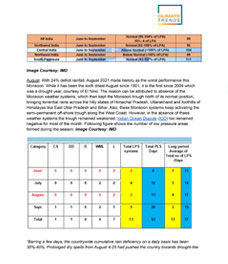
Monsoon 2021, a series of extreme weather events (September 2021)
The Monsoon season in 2021 has been a roller coaster ride. Weather models went haywire, making it the most pulsating season so far. While both the onset and withdrawal months made thumping beginning and end respectively, core monsoon months of July and August, failed miserably.

Monsoon rains to be impacted in places with highest levels of air pollution (August 2021)
As air pollution peaks in the coming years, scientists claim that Monsoon rains may reduce by at least 10 per cent or even more. While there has been a consensus across the scientific community that the rising air pollution levels would decrease the Monsoon rains substantially in the coming years, it might also result in unstable Monsoon patterns.

Raini Village, home of Chipko Aandolan needs to shift for its survival (July 2021)
A Himalayan case study of climate change, fragile ecosystem, unplanned development, and combined consequences. Raini Village, home to India’s most famous forest conservation movement ‘Chipko Aandolan’ is now a site too dangerous for its residents to live in.

Lightning, an increasing threat due to climate change (July 2021)
Damage due to natural hazards has been showing a rising trend in recent years and climate change is likely to make such events even more dangerous. What is of more concern is that both the severity and frequency of thunderstorm/dust storms/ lightning are expected to shoot up due to rise in global temperature.

Climate change fueling Monsoon mayhem in India, extreme weather events to rise further (July 2021)
India’s western coastal states of Maharashtra and Goa along with the Himalayan region of Himachal Pradesh and Uttarakhand have witnessed a spate of extreme weather events. Hundreds of people have lost their lives owing to deadly floods, cloud bursts and landslides.

Climate Change Impact: Powerful cyclones hold back onset of Southwest Monsoon (June 2021)
Exceptional warming of ocean waters triggered two very powerful cyclonic storms Tauktae and Yaas in Arabian Sea and Bay of Bengal, respectively. These systems had taken away much of the kinetic energy from the water bodies, which had almost ceased the weather activity in Kerala. Required wind pattern and speed too were absent and thus, delayed the onset of Southwest Monsoon 2021.
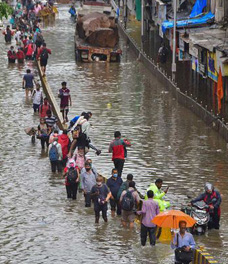
Mumbai Monsoon: Global warming and rising threat of floods to the maximum city (June 2021)
Multiple studies claim that India’s largest coastal cities, like Mumbai and Kolkata, are facing the severest threats from climate-induced flooding. Floods in Mumbai and Kolkata are attributed to the impact of climate shifts, urbanization, sea-level rise and other regional factors

India’s Monsoon Patterns are changing due to Climate Change: Experts (June 2021)
Indian Monsoon is a complex phenomenon and reportedly climate change and global warming has further accentuated the situation, with each year surpassing the earlier records.

Cyclone Yaas: Link with Cyclone Tauktae and Amphan (May 2021)
India was hit by cyclones Yaas and Tauktae in close succession, the former causing devastation in Odisha, Jharkhand and West Bengal, while the latter impacted the western coast. Both cyclones were preceded by very high sea surface temperatures reaching 31-32°C. Rising ocean temperatures in both the Bay of Bengal and Arabian Sea assisted these cyclones in their “rapid intensification” process. Otherwise, such a significant increase in the number of cyclones over the Bay of Bengal is not common, as it is in the Arabian Sea. This briefing details the science behind the cyclone’s intensity and connection to climate change.

Impact of Climate Change on Various Businesses and Industries in Maharashtra
Recognizing the importance of industry to the people and economy of the state of Maharashtra, Climate Trends commissioned a baseline survey to understand industry perception of risks, response and requirements in the state of Maharashtra to respond to climate change. The survey has been implemented by YouGov in December 2020 GDP.

COVID-19 recovery is a chance to climate-proof Indian farming (December 2020)
There is increasing evidence that climate change will impact agriculturally important areas, particularly coastal south India, central Maharashtra, the Indo-Gangetic plains and the Western Ghats. As farmers suffer more production losses, government expenditures will likely increase as private institutional funding dries up unable to withstand the risks. It is predicted that climate change impacts on agriculture will lead to a 1.5% loss in India’s GDP.

Extreme Rainfall across Western India (August 2020)
Less than two months ago, the western coast of India was bracing itself for cyclone Nisarga, and it is now dealing with a torrential downpour. The Indian Meteorological Department (IMD) predicts active monsoon conditions over the west coast including Mumbai and east coast of India and likely intense rainfall over Gujarat, Madhya Pradesh, Chhattisgarh and Odisha. Experts forecast a three-fold rise in extreme rains along the west coast and central India.
Cyclone Nisarga: link with climate change (June 2020)
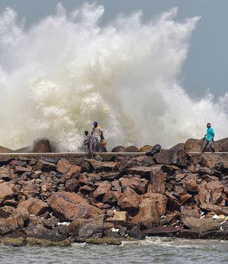
Less than two weeks after Cyclone Amphan made landfall, a second cyclone is expected to hit the coasts of India. The Indian Meteorological Department (IMD) said that Cyclone Nisarga is expected to intensify further into a Cyclonic Storm over East Central Arabian Sea and is likely to move nearly northwards initially till June 2nd morning and expected to re-curve north-north eastwards before making landfall near north Maharashtra and south Gujarat coasts on June 3rd morning.

India Locust Outbreak - Climate Change Briefing (May 2020)
The worst locust outbreak seen in a quarter of a century is currently ravaging West India and is an escalating danger to food security, threatening to spread further east. Several locusts waves are expected from now until early July, due to spring breeding in southern Iran and southwest Pakistan. The UN warned that the locusts swarm pose a “severe risk” to India’s agriculture this year. The locusts are currently active in Rajasthan, Gujarat, Maharashtra, Uttar Pradesh and Madhya Pradesh. Rajasthan is currently the most affected state, according to the Union Environment ministry.

Cyclone Amphan: link with climate change (May 2020)
A record-breaking storm, Cyclone Amphan, is forecast to land in India and Bangladesh on Wednesday 20 May in the late afternoon local time (see track forecast below and live tracking here). Amphan is now the strongest storm on record in the Bay of Bengal, with sustained wind speeds of 270kmh, making it stronger than a 1999 super cyclone, and the joint-strongest on record in the North Indian Ocean.

Cyclone Vayu (June 2019)
Briefing paper as an explainer for media journalists to establish the link of climate change and air pollution with cyclone Vayu in June 2019.

Cyclone Maha (June 2019)
Briefing paper as an explainer for media journalists to establish the link of climate change and air pollution with cyclone Fani in June 2019.
Cyclone Fani (May 2019)
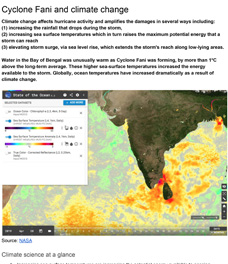
Briefing paper as an explainer for media journalists to establish the link of climate change with cyclone Fani in May 2019.